Your business runs on software. AI Development is the key to moving forward.
That’s why the pressure to ship faster without compromising quality, security, or compliance has never been higher. A Harvard Business Review Analytic Services white paper, sponsored by AWS, lays out exactly how high-performing engineering organizations are meeting that challenge.
The report calls out four interrelated pillars of modern software development. Get them right, and you innovate. Get them wrong, and you accumulate legacy debt that will slow you down for years.
Here’s the distilled version for engineering leaders — plus a path to upskill your team on AWS.
Forrester analyst Diego Lo Giudice frames it bluntly: software is how your business expresses itself. Every process, policy, and service runs through it.
By 2028, Forrester expects software delivery to look radically different — teams building applications at speeds that seem impossible today. The organizations that get there will be the ones that redesign their entire pipeline, not just their code editor.
The four pillars that get you there:
Speed and agility
Visibility through testing and observability
AI-powered development agents and automation
Embedded security and governance
Let’s break them down.
Pillar 1: Speed and Agility
Traditional waterfall development is dead and has been since Agile and DevOps took over. Development leaders already know this, but the execution gap is real.
AT&T’s Brian Hinshaw shared a telling data point in the report. Before modernizing, his team shipped one or two apps a year. After embracing modern practices — microservices, low-code platforms, and DevOps — productivity exploded to 60 or 70 apps per quarter.
That’s not a typo. That’s a 100x throughput improvement.
How? A combination of:
Microservices architecture that decouples deployment from monoliths
Automated CI/CD pipelines for frequent, reliable releases
Agile methodology paired with DevOps tooling (Accenture’s Adam Burden notes you can’t really do one without the other)
According to the Continuous Delivery Foundation, 83% of developers are already involved in DevOps activities. If your team isn’t, you’re already way behind.
Pillar 2: Improved Visibility Through Observability
Monitoring is not observability. That distinction matters more every year.
Capital Group’s Shawn Landreth describes joining a company that operated on a “distress protocol” — fix it after customers complain. A decade ago, that might have worked when systems were monolithic and had three layers. Today’s microservices architectures make that approach dangerous.
His team rebuilt around observability: predictive analytics on historical data, AI-driven noise reduction, and cross-functional operational calls that pull desktop support, help desk, and engineering into the same conversation.
The result? They cut 13,000 daily alerts down to under 1,000. Still a lot — but now actionable.
Pillar 3: AI-Powered Agents Automation
This is the pillar that’s changing fastest. Coding agents are changing the landscape!
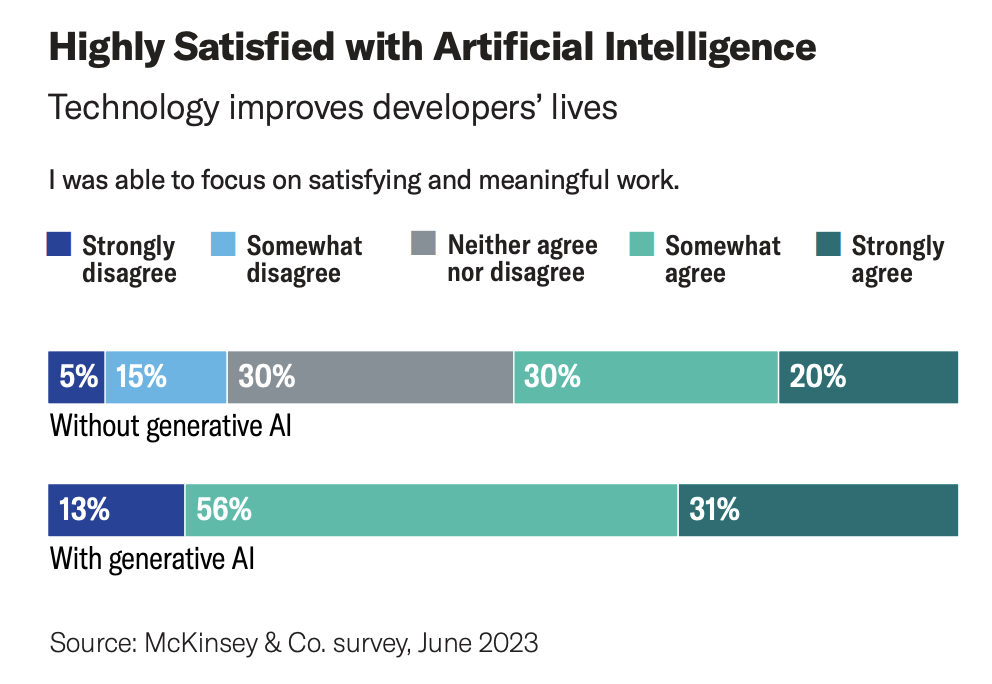
A McKinsey study found that 87% of developers using generative AI reported being able to focus on meaningful work — compared to just 50% of developers without it. That’s a massive quality-of-work gap, and it translates directly into retention and velocity.
Where is AI actually delivering? The HBR report highlights:
Code generation — natural language to working functions
Test case generation and defect prediction — Boston Consulting Group is embedding this into their QA process right now
Alert triage and root cause analysis — AI sitting in the middle of the observability stack
Predictive project analytics — forecasting delays before they happen
💡 The key insight: AI isn’t replacing developers. It’s absorbing the tedious work so humans can do the creative work. As you know, this study needs to look again for 2026 as coding agents are taking over. Our new article on Kiro and Claude Code will dive deep into using these with AWS. Of course, there are others and more keep popping up.
Pillar 4: Embedded Security and Governance
Speed without guardrails is how you end up in a breach notification.
U.S. Steel’s Adam Airhart inherited a decade of legacy systems with an unclear risk profile. His fix wasn’t dramatic. He started with version control on an AI-powered platform, then added build-and-release pipelines, and then added approval gates at every critical transition.
Developers got instant feedback. Security became part of the flow instead of a gate at the end.
This is the DevSecOps model, and it’s non-negotiable for regulated industries. HealthTech and FinTech leaders especially feel this — compliance isn’t optional, and bolting it on after the fact costs 10x more than building it in.
Accenture’s Burden warns against both extremes: too strict, and you kill innovation, too loose, and you build future technical debt. The companies that win have strong central governance paired with architects who can translate policy into developer-friendly guardrails.
The Skills Gap Is the Real Bottleneck
Here’s the uncomfortable truth. The pillars are well understood. The tooling exists. AWS provides the services.
What’s missing at most organizations is a team trained to actually execute.
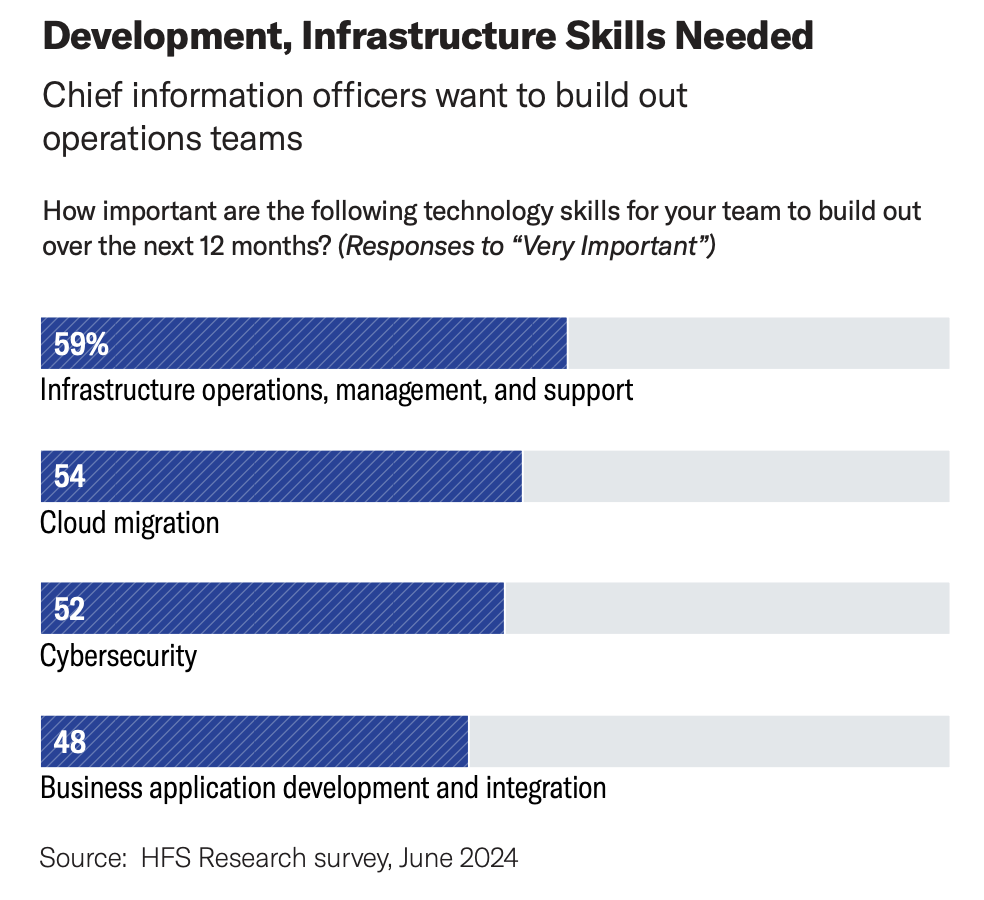
HFS Research found that 59% of CIOs rate infrastructure operations skills as “very important” to build out in the next 12 months. Cloud migration, cybersecurity, and business application development follow close behind.
If you’re an engineering leader, you have two options: wait for the market to solve your hiring problem, or upskill the team you have.
Two Training Paths to Get Your Team There
Tech Reformers is an AWS Authorized Training Provider and AWS AI Champion. We built our curriculum around the exact pillars HBR identifies.
This is the foundational course for experienced developers moving workloads to AWS. Your team will build a full cloud application — IAM permissions, S3 and DynamoDB integration, Lambda functions, API Gateway, Cognito authentication, and X-Ray observability. DevOps practices are embedded throughout.
It directly addresses Pillars 1, 2, and 4. Microservices, serverless, observability, and security patterns are all hands-on.
This is Pillar 3, operationalized. Your team will build production-ready generative AI solutions on AWS — foundation model selection, vector databases with Amazon Bedrock Knowledge Bases, prompt governance, agentic AI with AgentCore, AI safety guardrails, and cost optimization.
This is the course for teams that have moved past ChatGPT experiments and need to ship enterprise-grade AI with real governance.
Advanced level.
Change Is the Only Certainty
Lo Giudice closes the HBR report with a line that should be taped to every engineering leader’s monitor: “Agile transformation is a process that never ends.”
Three years ago, nobody predicted ChatGPT would redefine software development. Three years from now, something else will.
Your modern software practices need to be ready for anything — because change itself is the only constant.