pixel John Krull, Author at Tech Reformers

Author Archives: John Krull

Transit Gateway

If you run more than one VPC, or you’re about to set up your first Site-to-Site VPN back to an office or data center, there’s a decent chance AWS Transit Gateway belongs in your architecture sooner than you think. It’s usually framed as a large-enterprise tool, but the way it’s priced and provisioned makes it just as useful for a five-VPC startup as it is for a Fortune 500 network team. And this week, it got a lot more capable: AWS just announced the general availability of Policy-Based Routing (PBR) on Transit Gateway, giving network architects a level of traffic control that previously required expensive workarounds.

This post covers both halves of that story: what Transit Gateway is and why it’s worth considering even for a small AWS footprint, and what this new Policy-Based Routing capability actually changes for security, hybrid connectivity, and certification prep.
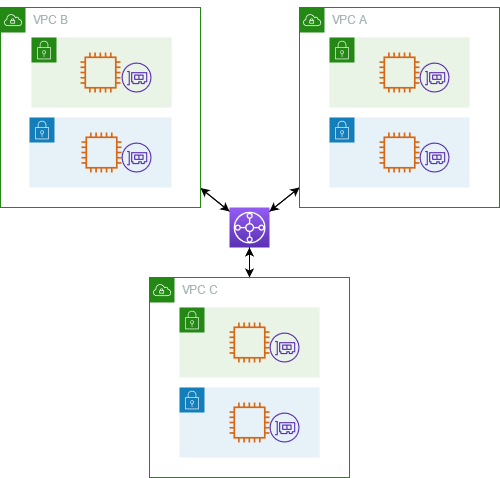
Transit Gateway

Key takeaways

  • AWS Transit Gateway is a managed, pay-as-you-go network hub — you can start with a single VPN attachment and scale up without re-architecting.
  • Policy-Based Routing (PBR), GA as of July 2026, lets Transit Gateway route traffic based on source/destination IP, port, and protocol — not just destination IP.
  • PBR simplifies traffic inspection, hybrid path selection (VPN vs. Direct Connect), and environment isolation without extra VPCs or attachments.
  • It’s already exam-relevant for the AWS Certified Advanced Networking – Specialty and AWS Certified Solutions Architect – Professional certifications.

What Is AWS Transit Gateway, and Why Should Smaller AWS Customers Care?

AWS Transit Gateway is a managed network transit hub that connects VPCs, VPNs, and AWS Direct Connect links through a single, central gateway, rather than a tangle of point-to-point connections. AWS describes it as giving you “better visibility and control” as your network grows — and that growth is really the point.

Most write-ups about Transit Gateway assume you already have dozens of VPCs and a full-time network team. In practice, it earns its keep much earlier than that. Here’s the pattern we see most often with smaller AWS environments:

  • You need a Site-to-Site VPN back to an office or existing data center. Instead of attaching that VPN directly to a single VPC, you attach it to a Transit Gateway. The VPN attachment itself works almost identically either way — see AWS’s own Site-to-Site VPN setup guide — but routing through a Transit Gateway means that connection isn’t locked to one VPC forever.
  • You add a second VPC (a new environment, a new team, an acquisition, a new region). Instead of standing up a new VPN or a peering connection, you attach the new VPC to the Transit Gateway you already have, and it inherits the existing hybrid connectivity automatically.
  • You eventually add Direct Connect for more predictable latency or bandwidth. It attaches to the same gateway, alongside your VPN, without touching your VPC route tables.

The pricing model supports this incrementally: Transit Gateway bills by the hour per attachment plus data processed (see the official pricing page), so a single VPC and a single VPN attachment cost very little to run. You’re not paying an “enterprise tax” to keep the door open for growth. You’re just paying for what you use, with the option to expand later without a redesign. AWS’s own walkthrough on scaling VPN throughput using Transit Gateway is a good example of exactly this kind of incremental growth in action.
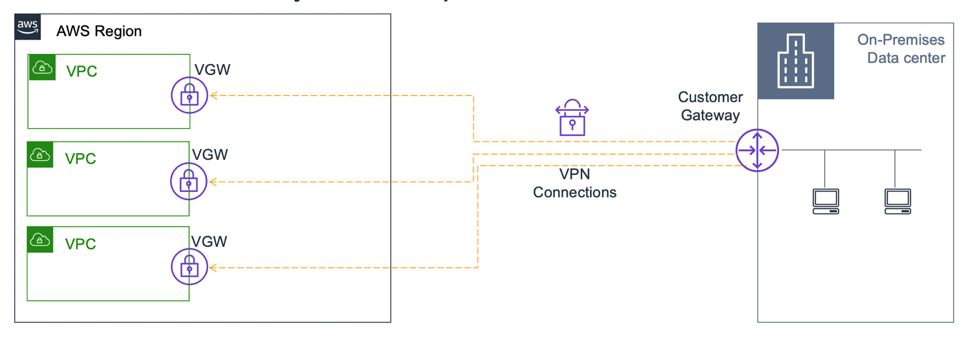
Transit Gateway with VPN

In other words: if you’re setting up your first VPN connection to AWS right now, it’s worth attaching it to a Transit Gateway from day one, even if you only have one VPC. It costs just a bit extra today and saves you a lot on a migration later. For the full mechanics of how traffic actually moves through the gateway, AWS’s “How Transit Gateway works” doc is the best primary source.


Transit Gateway Grows Up: Policy-Based Routing Brings Enterprise-Grade Traffic Control

That’s the foundation. Now here’s what changed this week for everyone already running Transit Gateway at scale.

Transit Gateway has long been the backbone of large-scale AWS network architectures, connecting VPCs, on-premises environments, and hybrid workloads at scale. But its routing model had a well-known limitation: forwarding decisions were based solely on destination IP address, which meant complex traffic-steering scenarios required creative and often costly workarounds. That changes with the general availability of Policy-Based Routing (PBR) on AWS Transit Gateway. This single capability addition has meaningful implications for how enterprise networks are designed, how security is enforced, and how certification candidates need to think about AWS routing architecture.

What Policy-Based Routing on Transit Gateway Actually Does

Traditional routing on Transit Gateway uses route tables that match on destination IP prefix — straightforward, but limited when you need to treat traffic differently based on where it came from, what port it uses, or what protocol it carries. Policy-Based Routing changes the decision model. With PBR, you create a policy table and associate it with a Transit Gateway attachment. Inside that table, you define an ordered list of rules, each evaluating packet attributes — source IP, destination IP, port, and protocol — rather than destination IP address alone. When a packet matches a rule, it’s forwarded to a designated route table, using first-match-wins logic for deterministic, predictable traffic classification.

Why This Matters for Security and Compliance Architectures

One of the most immediate use cases is inline traffic inspection. Before PBR, steering specific workloads through AWS Network Firewall or a third-party inspection appliance often required dedicated VPCs, extra routing hops, and additional Transit Gateway attachments just to create the path separation needed — a pattern AWS documents in its own guidance on connecting Transit Gateway directly to Network Firewall. Now, a security architect can write a policy rule that says: any traffic originating from the production application subnet, using HTTPS on port 443, goes to the inspection route table — and everything else takes a standard path. This shrinks the blast radius of a redesign, reduces the number of VPCs required for workload isolation, and cuts the operational overhead of maintaining parallel routing topologies. For organizations operating under PCI-DSS, HIPAA, or FedRAMP requirements, this kind of deterministic traffic steering is not a nice-to-have — it’s a compliance requirement.

Hybrid Connectivity Gets More Flexible Too

PBR also unlocks smarter use of hybrid connectivity paths. Enterprises running both AWS Direct Connect and AWS Site-to-Site VPN often want to route certain traffic types — say, database replication or backup jobs — over the lower-cost VPN path, while sending latency-sensitive application traffic exclusively over Direct Connect. Previously, achieving this required separate attachment architectures or complex BGP manipulation. With PBR, you write rules that classify traffic by source subnet and protocol, directing each class to the route table associated with the correct hybrid path. Network engineers get the traffic-engineering control they’re used to from on-premises MPLS environments, expressed natively in the AWS console, CLI, or SDK — with no additional charge beyond standard Transit Gateway fees.

A Real-World Scenario: Isolating Environments Without Doubling Your Infrastructure

Imagine a mid-sized enterprise running production, staging, and development environments across multiple VPCs, all connected through a single Transit Gateway. The security team wants to ensure development traffic can’t reach production subnets — lateral movement is a real concern — but doesn’t want to stand up a separate Transit Gateway and replicate the entire connectivity model. With PBR, the network team creates a policy table that matches on source IP ranges belonging to the development VPC and directs that traffic to a restricted route table with no routes to production CIDRs. Production traffic follows a separate policy rule to a route table with full connectivity plus a mandatory pass-through the Network Firewall attachment. Two environments, one Transit Gateway, one policy table, clean separation — and the whole thing is auditable through AWS CloudTrail.

Certification and Career Implications
Solutions Architect Professional badge

This announcement sits squarely within the scope of the AWS Certified Advanced Networking – Specialty exam, particularly the domains of network architecture design, traffic management, and hybrid connectivity. It also surfaces in the AWS Certified Solutions Architect – Professional exam in scenarios requiring workload isolation, cost-optimized routing, and security-integrated architectures. For CloudOps engineers, PBR introduces a new operational artifact — the policy table — that needs to be understood, monitored, and maintained as part of the Transit Gateway lifecycle. Expect scenario-based exam questions asking you to select the most operationally efficient way to achieve traffic inspection or environment isolation, where PBR is the correct answer over legacy multi-VPC workarounds. If you’re studying for either exam right now, add Transit Gateway Policy-Based Routing to your active review list immediately.


Frequently Asked Questions

Is AWS Transit Gateway worth it for a small AWS account?

Often, yes — especially if you’re setting up your first Site-to-Site VPN. Attaching that VPN to a Transit Gateway instead of directly to a VPC costs little extra and lets you add VPCs, sites, or Direct Connect later without re-architecting your network.

What is Policy-Based Routing (PBR) on AWS Transit Gateway?

PBR is a routing capability, generally available as of July 2026, that lets Transit Gateway forward traffic based on source IP, destination IP, port, and protocol, instead of destination IP address alone.

Does Policy-Based Routing cost extra?

No. According to AWS, PBR is included at no additional charge beyond standard Transit Gateway fees.

Which AWS certifications cover Transit Gateway PBR?

It’s directly relevant to the AWS Certified Advanced Networking – Specialty exam and shows up in scenario questions on the AWS Certified Solutions Architect – Professional exam.


Start Applying This, Not Just Knowing It

Reading about PBR is a start, but the real learning happens when you build a policy table, write a few rules, and watch traffic take different paths based on protocol and source. At TechReformers, we layer real-world scenarios and hands-on labs on top of the official AWS curriculum so what you learn sticks — and transfers directly to both the exam room and the architecture whiteboard. Whether you’re preparing for a certification, upskilling your enterprise network team, or setting up your very first VPN into AWS, this is a capability worth understanding early. Visit us at techreformers.com to explore our upcoming networking courses and labs, and follow TechReformers so you never miss a capability change that matters to your career.

Kiro Spec-Driven Development

A new two-day, instructor-led course teaches developers to bring structure, correctness, and governance to agentic software development — using AWS’s own agentic IDE.

KIRO spec-driven development

Every developer who has spent an afternoon “vibe coding” with an AI assistant knows the pattern: you describe what you want, the agent produces plausible-looking code, and twenty minutes later you’re untangling a feature that solved the wrong problem, missed an edge case, or quietly diverged from what the team actually needed. Prompting is fast. It just isn’t a substitute for planning — and as AI agents take on more of the actual engineering work, that gap turns into real technical debt.

Kiro, AWS’s agentic IDE, was built specifically to close that gap. Instead of jumping straight from prompt to code, Kiro has the agent work through requirements, design, and a sequenced task plan first — turning a request into a spec the agent (and your team) can actually review before a single line ships. As Kiro’s own site puts it: most tools are great at generating code, but Kiro gives structure to the chaos before you write a single line. Tech Reformers is now offering Spec-Driven Development with Kiro, a two-day hands-on course that teaches you exactly how to put that structure to work.


Spec-driven development is a discipline — but it lives or dies on the tooling that supports it, and Kiro was built around it from the ground up rather than bolting it on:

  • Specs as the unit of work. Every feature moves through Requirements, Design, and Tasks phases before implementation begins, using EARS notation to make requirements unambiguous and reviewable — by humans and by the agent.
  • Correctness you can trust. Kiro applies property-based testing — asserting rules that must hold across all inputs, closer to fuzz testing than traditional unit tests — to catch the edge cases a quick prompt-and-check cycle misses.
  • Agent behavior you control. Steering files, context providers, and Autopilot vs. Supervised execution modes mean you decide how much autonomy the agent gets, on a project-by-project or even task-by-task basis.
  • An ecosystem, not a walled garden. Kiro connects to your existing toolchain through Model Context Protocol (MCP) servers, the Agent Client Protocol, Skills.md, and Open VSX extensions — plus direct integrations with tools like Figma, Terraform, and Postman.
  • Built for teams, not just individuals. Agent hooks automate recurring workflows, agent skills package reusable expertise, and shared steering plus enterprise governance (MCP registry allowlisting, model governance, extension management) mean Kiro scales from a single developer to an organization.
  • Work where you already do. Kiro is available as a full IDE, a CLI, a web platform with cloud sandboxes, and a mobile interface — with the flexibility to choose Claude models, open-weight alternatives, or an Auto mode that balances capability and cost.

That combination — structured planning, verifiable correctness, controllable autonomy, and real governance — is what separates a tool for demos from a tool for production engineering. It’s also exactly what this course is built to teach.

Day 1 starts with the agentic coding paradigm and the five principles of effective agentic development, then goes hands-on with the core spec workflow: Requirements-First and Design-First approaches, EARS notation, and property-based testing for correctness. You’ll learn to control agent behavior with steering files, execution modes, and trusted commands, and close the day with Bugfix Specs — using the same disciplined, spec-first approach to root-cause analysis and regression-safe fixes. Labs are interleaved throughout, and you’ll progressively build a weather application using each capability as it’s introduced.

Day 2 moves from individual workflow to team- and platform-scale: connecting MCP servers and tools, installing and authoring Kiro Powers to solve the context-overload problem, and automating work with agent hooks, agent skills, and custom subagents. The day closes with team collaboration and enterprise governance — shared .kiro configuration, spec review conventions, and the controls that let an organization roll this out safely. You’ll apply it all by extending and team-enabling a pre-built micro-blogging application.

This course is intended for software developers and engineers, technical leads adopting AI-assisted development workflows, development teams moving into agentic coding practices, and DevOps engineers integrating AI agents into delivery pipelines.

Come in with some knowledge in at least one programming language, working knowledge of Git, a basic understanding of RESTful APIs and cloud application concepts, and foundational familiarity with generative AI concepts (LLMs, tokens, inference).

Upcoming sessions

All sessions run online, 9:00 AM – 5:00 PM Central Time, $1,000 per person for the two-day course.

DatesDaysTimeRegister
Aug 6–7, 2026Thu–Fri9am–5pm CDTRegister
Sep 3–4, 2026Thu–Fri9am–5pm CDTRegister
Oct 5–6, 2026Mon–Tue9am–5pm CDTRegister
Nov 3–4, 2026Tue–Wed9am–5pm CSTRegister

Taught by John Krull. Seats are limited per session — register early to lock in your preferred date.

Full course details, prerequisites, and registration are on the Spec-Driven Development with Kiro course page, or browse the full course catalog to see everything Tech Reformers offers.

Agentic AI pathway from Tech Reformers

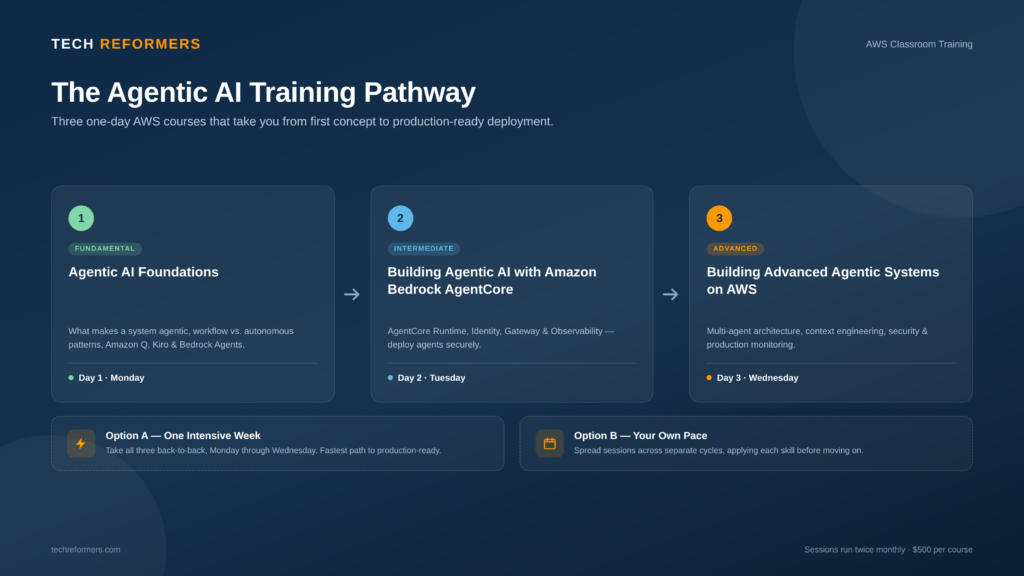
Three new instructor-led courses take you from foundational agentic concepts to deploying secure, observable multi-agent systems – on a schedule that fits your team. Tech Reformers offers an Agentic AI pathway for developers.

Agentic AI has moved fast from research demo to boardroom priority. In the space of a year, the conversation shifted from “what can a chatbot answer?” to “what can an autonomous agent actually do?” We now plan tasks, call tools, coordinate with other agents, and complete real work with minimal human hand-holding. AWS has built out a platform for this shift, anchored by Amazon Bedrock AgentCore, and Tech Reformers has built the training pathway to match it.

Your Agentic AI development pathway

We now offer three one-day, instructor-led courses that take you from your first agentic concept to a production-ready, multi-agent deployment: Agentic AI Foundations, Building Agentic AI with Amazon Bedrock AgentCore, and Building Advanced Agentic Systems on AWS. Each stands on its own, but together, as an agentic ai pathway, they form a deliberate roadmap. And we’ve scheduled them so you can take that pathway however it works best for you.

The pathway

Agentic AI Foundations (Fundamental, 1 day) Start here if you’re new to agentic AI. You’ll trace the evolution from large language models to autonomous agents, learn what actually makes a system “agentic,” and compare workflow, autonomous, and hybrid agent patterns. You’ll get hands-on with Amazon Q, Kiro, and Amazon Bedrock Agents, and see how Amazon Bedrock AgentCore fits into the picture — including a lab building agents integrated with Bedrock Knowledge Bases and Guardrails.

Building Agentic AI with Amazon Bedrock AgentCore (Intermediate, 1 day). This is where proof-of-concept becomes production. You’ll deploy agents with AgentCore Runtime, secure them with AgentCore Identity and Policy, connect tools through AgentCore Gateway and the Model Context Protocol, implement agentic memory, and set up AgentCore Observability so you actually know what your agents are doing once they’re live.

Building Advanced Agentic Systems on AWS (Advanced, 1 day) The capstone. You’ll design multi-agent architectures and communication patterns, apply context engineering to keep performance and cost in check, implement VPC integration and policy-based access control, and build out distributed tracing and evaluation frameworks – all through the lens of the AWS Well-Architected Framework, so what you build is genuinely ready for production.

Agentic AI Learning Pathway

Two ways to take it

Because the Agentic AI pathway is built from three self-contained one-day courses, you get to choose the pace.

Go all in, one week. Each cycle, we run all three courses back-to-back — Monday, Tuesday, Wednesday, same week. If your team is standing up an agentic AI initiative now, this is the fastest way through: the concepts from Monday are still fresh when you build on them Tuesday and Wednesday, and you’re production-ready by the end of the week instead of the end of the quarter.

Spread it out. Prefer to apply what you learn before moving to the next course? Take Foundations one month, AgentCore the next, and Advanced Systems when you’re ready. You’re only out of the office for one day at a time, and the gap between sessions gives you room to try the concepts against a real project before you add the next layer.

Either way works — the courses are designed to build on each other in order, so we recommend taking them Foundations → AgentCore → Advanced Systems regardless of how much time you put between them.

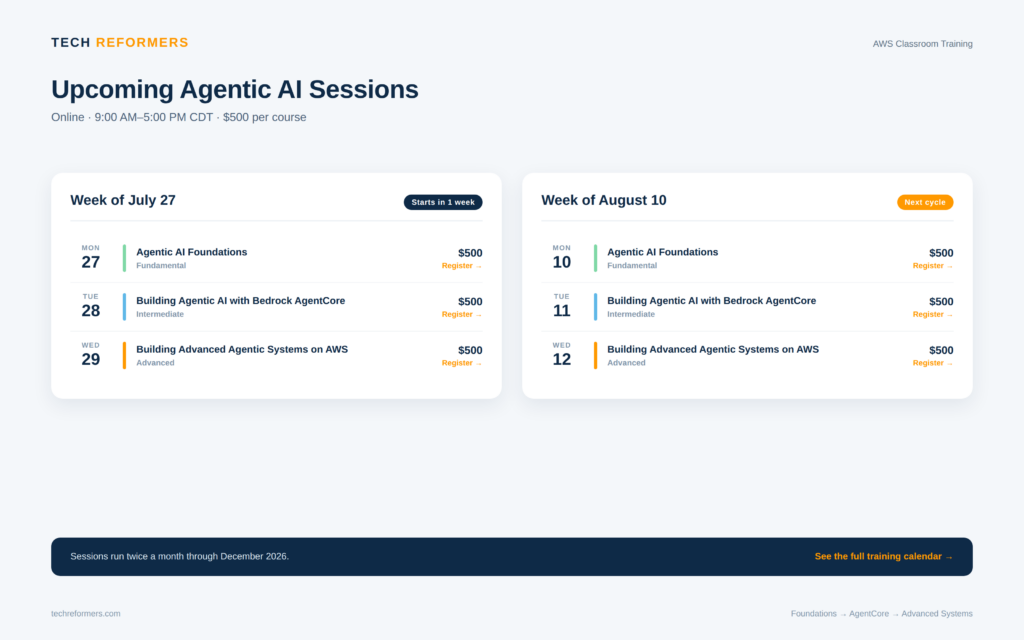
Upcoming sessions

Agentic AI pathway schedule

All sessions run online, 9:00 AM – 5:00 PM CDT, $500 per course.

Week of July 27, 2026

DayCourseRegister
Mon, July 27Agentic AI FoundationsRegister
Tue, July 28Building Agentic AI with Amazon Bedrock AgentCoreRegister
Wed, July 29Building Advanced Agentic Systems on AWSRegister

Week of August 10, 2026

DayCourseRegister
Mon, Aug 10Agentic AI FoundationsRegister
Tue, Aug 11Building Agentic AI with Amazon Bedrock AgentCoreRegister
Wed, Aug 12Building Advanced Agentic Systems on AWSRegister

(For the August 10 and 11 sessions, the link goes to the course page — pick the August date from the session list there.)

We run this pathway twice a month through the end of the year, so if these dates don’t work, check our full training calendar for the next opportunity.

Who this is for

This agentic ai pathway is built for software developers and technical professionals who are moving beyond chatbot-style generative AI into autonomous, tool-using systems — whether you’re just getting oriented, evaluating which AWS services fit your use case, or ready to take a multi-agent system into production. Current users of Amazon Q Developer, Amazon Q Business, or Amazon Bedrock Agents will find the pathway a natural next step.

Get started

Browse the full course catalog or jump straight to Agentic AI Foundations to reserve your seat. Seats are limited per session. Register early to lock in the week (or the pace) that works for you.

The Origin Story That Explains Everything About Cloud Architecture

SQS birthday cake

Amazon SQS launched on July 13, 2006, as one of only three services AWS offered at the time, alongside EC2 and S3. That starting lineup is deeply instructive. Compute, object storage, and a message queue. AWS essentially told the world from Day One that distributed systems need a way to pass messages between components without locking them into direct dependencies. The engineers at Amazon had already lived through the pain of tightly coupled internal systems and built SQS to solve a very real operational problem. That origin story isn’t just historical color; it’s the conceptual foundation behind every loosely coupled architecture pattern you’ll encounter on AWS certification exams today.

What SQS Actually Does and Why It Still Matters

At its core, SQS is a fully managed message queuing service that allows different parts of an application to communicate asynchronously. Instead of Service A calling Service B directly and waiting for a response, Service A drops a message into a queue, and Service B picks it up when it’s ready. This seemingly simple shift has enormous consequences for system resilience, scalability, and fault tolerance. SQS offers two queue types: Standard queues for maximum throughput with at-least-once delivery, and FIFO queues for exactly-once, ordered message processing. Features such as visibility timeouts, dead-letter queues, message retention periods, and long polling give architects precise control over how messages flow through a system. These aren’t just configuration options; they’re the building blocks of production-grade distributed architectures.

Where SQS Shows Up on AWS Certification Exams

  • AWS Certified Solutions Architect: SQS is woven through multiple exam domains. Designing resilient architectures, building loosely coupled systems, and choosing the right messaging service for a given scenario are all tested areas where SQS knowledge is essential.
  • AWS Certified Developer: candidates need to go deeper, understanding API-level behavior, how to handle duplicate messages, how to configure dead-letter queues programmatically, and when FIFO ordering is necessary.
  • Cloud Practitioner exam: SQS represents a core cloud concept: the shift from tightly coupled, monolithic systems to loosely coupled, managed-service architectures.

One of the most common exam traps is confusing SQS with SNS or Kinesis. Knowing the differences between queuing, pub/sub, and streaming is a tested skill across multiple certification paths is essential.

A Real-World Scenario: Order Processing at Scale

Imagine a retail company running a high-traffic e-commerce platform during a major sales event. Their order service processes thousands of transactions per minute, each of which must trigger downstream processes — inventory updates, payment confirmations, shipping notifications, and fraud checks. If these services are directly connected, a slowdown in any one of them can cascade, bringing the entire order pipeline to a halt. By placing SQS queues between each service boundary, the Solutions Architect ensures that orders are never lost, each downstream service processes at its own pace, and failures in one component don’t propagate to others. A dead-letter queue captures any messages that fail to be processed after a configured number of attempts, providing the CloudOps team with a clean mechanism for investigation and retries. This is the pattern AWS has been recommending since 2006 — and it’s the same pattern that appears on exam scenario questions today.

Keep Building on the Foundations That Matter

Amazon SQS turning 20 is a reminder that cloud mastery starts with understanding the services that have stood the test of time. Whether you’re preparing for your first AWS certification or deepening your expertise as a practicing architect or CloudOps engineer, SQS belongs in your knowledge toolkit. At TechReformers, we bring the official AWS curriculum to life with real-world context, hands-on labs, and practical scenarios exactly like the ones described here. Ready to build architectures that actually work — and pass the exams that prove it? Visit us at https://techreformers.com and let’s get to work.

AWS Certifiation renewal

AWS just made one of the most learner-friendly changes to its certification program in years, and if you hold an AWS certification — or are working toward one — this news directly affects how you plan your career development. Starting today, AWS certified professionals have a new option for keeping their credentials current: completing curated training and hands-on labs on AWS Skill Builder instead of sitting through a full certification exam retake. This isn’t a workaround or a shortcut — it’s a structured, AWS-sanctioned pathway designed to reflect the realities of how cloud professionals actually grow their skills. The implications stretch from individual learners managing busy schedules to enterprise teams trying to keep entire workforces certified without grinding through exam cycles. Let’s break down exactly what changed, who it affects, and how to take full advantage of it.

What Exactly Changed in the AWS Certification?

Previously, maintaining an AWS Certification meant one thing at renewal time: schedule the exam, prep for weeks, and sit back down in the testing chair. AWS has now introduced an alternative renewal pathway through AWS Skill Builder — the official AWS online learning platform — where credential holders can complete curated courses and hands-on labs to earn an additional year of certification validity. This pathway is not self-directed in the loose sense; the training is curated specifically for recertification, meaning it’s designed to cover updated service knowledge and evolving best practices. Think of it less like browsing a course catalog and more like a structured continuing education program. The full exam option still exists and remains the primary path for first-time certification — this new option applies specifically to renewal.

Why This Matters for AWS Certification Candidates?

If you’re currently studying for any AWS certification — Cloud Practitioner, Solutions Architect Associate or Professional, Developer Associate, CloudOps Administrator, Machine Learning Specialty, Advanced Networking, Security Specialty, or any other in the AWS portfolio — this announcement signals something important about how AWS values continuous, practical learning over pure exam performance. It validates the idea that hands-on labs and scenario-based training are legitimate measures of competency, not just stepping stones to a test. For candidates, this also means the skills you build while preparing for your exam — using AWS Skill Builder, doing labs, working through real scenarios — are the same skills that will serve you at renewal time. The investment you make in deep, practical learning now pays dividends well beyond exam day. This is a strong argument for choosing training providers who emphasize real-world context and hands-on practice rather than exam dumps and memorization.

What This Looks Like in the Real World

AWS Certification recertification program

Consider a Solutions Architect at a mid-size company who earned their AWS Certified Solutions Architect – Professional two years ago. Their renewal window is approaching, but a major cloud migration project is consuming their entire schedule — blocking out six weeks to re-prep for a grueling exam simply isn’t realistic. Under the new pathway, they can work through curated AWS Skill Builder labs covering updated architectural patterns, newer services such as Amazon Bedrock, and current Well-Architected best practices — all on a schedule that fits their project work. Their certification stays current, their skills stay sharp on topics that are directly relevant to the work they’re doing right now, and their employer doesn’t lose a key certified resource during a critical delivery window. This is the kind of real-world flexibility that makes certification programs more sustainable for working professionals.

Enterprise Teams: A New Way to Manage Certification at Scale

For organizations managing large pools of AWS-certified employees — cloud centers of excellence, consulting firms, managed service providers, and AWS Partners — this change has significant operational value. Recertification exam logistics at scale are expensive and time-consuming, requiring individual scheduling, testing fees, and productivity gaps while employees prepare. A curated lab-based renewal pathway allows L&D teams to integrate renewal activities into regular training cycles, making certification maintenance a continuous process rather than a stressful annual sprint. Enterprise learning leaders should begin mapping their certification expiration calendars now and identifying which team members can leverage the Skill Builder renewal path in the coming months. AWS Partner organizations in particular should pay close attention, as certified headcount directly affects partnership tier requirements.

How TechReformers Supports Your Renewal and AWS Certification Journey

At TechReformers, an AWS Authorized Training Partner, we deliver official AWS curriculum enriched with hands-on labs, real-world scenarios, and instructor-led context that goes beyond the slide deck. Whether you’re preparing for your first AWS certification or navigating the renewal process, we help you build the kind of durable, practical cloud knowledge that holds up in the real world — not just in a testing center. The shift toward lab-based renewal paths is completely aligned with how we’ve always believed technical skills should be developed and validated. Our instructors bring live AWS environment experience to every session, so what you learn maps directly to AWS-recognized renewal-worthy skill development.

Certifications supported by this kind of deep learning include the AWS Certified Solutions Architect (Associate and Professional), AWS Certified Cloud Practitioner, AWS Certified Developer – Associate, AWS Certified CloudOps Administrator – Associate, AWS Certified Machine Learning – Specialty, AWS Certified Security – Specialty, and AWS Certified Advanced Networking – Specialty — among others. Job roles that benefit include Solutions Architects, Cloud Engineers, CloudOps professionals, DevOps practitioners, and AI/ML developers.

Ready to take control of your AWS certification journey? Visit us at https://techreformers.com to explore upcoming training, hands-on labs, and enterprise learning programs built to keep your team certified and career-ready.

What Amazon Bedrock AgentCore Payments Means for Your AWS Career

The line between “AI assistant” and “autonomous business operator” just got a lot thinner. Amazon Bedrock AgentCore has entered preview with managed payment capabilities that allow AI agents to independently purchase access to APIs, MCP servers, web content, and other agents. Built in collaboration with Coinbase and Stripe (press releases), this capability addresses one of the biggest friction points in agentic AI architectures: the messy, custom-built billing and credential plumbing that teams previously had to build themselves. For AWS practitioners, certification candidates, and enterprise architects, this is not just a product update, it is a signal of where cloud architecture is heading. Understanding it now puts you ahead of the curve on both the exam and in the field.

What Is Amazon Bedrock AgentCore and Why Do Payments Matter?

AgentCore icon

Amazon Bedrock AgentCore is AWS’s managed runtime environment for deploying, running, and orchestrating AI agents at scale. Until now, when an agent needed to call a paid external API or access a licensed data source, a human or a custom middleware system had to handle the billing side of that transaction. The new payments capability changes that by giving agents a governed, managed way to transact autonomously. Think of it as giving your AI agent a corporate credit card with built-in controls This removes what AWS calls “undifferentiated heavy lifting,” meaning teams no longer need to engineer custom billing flows just to make their agents functional in the real world.

How This Changes Agentic Architecture on AWS

Agentic AI design has always involved four core concerns: reasoning, tool use, memory, and action. Payments now become a first-class “action” type within that framework. Previously, cost and access management for external services was a design blocker that pushed complexity back onto developers. With managed payments baked into AgentCore, architects can design agents that are truly end-to-end autonomous within defined guardrails. The MCP (Model Context Protocol) server integration point is particularly important, as MCP is fast becoming a standard interface for tool-enabled agents.

A Real-World Scenario: The Autonomous Research Agent

Imagine a pharmaceutical company building a competitive intelligence agent using Amazon Bedrock. The agent’s job is to monitor scientific literature, query licensed research databases, and summarize findings daily. Previously, whenever the agent needed to access a paid PubMed API tier or a licensed data feed, a developer had to manually provision credentials and billing accounts. With AgentCore payments, the agent can autonomously request and pay for access mid-task using pre-approved spending parameters. A Solutions Architect designing this system now needs to think about agent spend policies, Bedrock Guardrails, IAM roles scoped to payment actions, audit logging via AWS CloudTrail, and integration with AWS Cost Explorer for visibility. This is exactly the kind of multi-service, real-world scenario that shows up in professional-level certification scenarios.

What Enterprise Teams Should Be Evaluating Right Now

For enterprise cloud teams, the arrival of autonomous-agent payments raises important governance questions that require answers before production deployment. Who owns the spending policy for an agent? How are payment credentials rotated and secured? What happens when an agent hits a spending threshold mid-task? These are architectural and operational requirements that need to be built into any agentic system design. AWS’s partnership with Coinbase and Stripe suggests that both traditional web transaction and blockchain-based payment rails are in scope, which broadens the integration surface considerably. Forward-thinking cloud teams should be piloting this in preview now, documenting their governance patterns, and building internal runbooks.

Next Steps for AgentCore Payments

decorative $

Amazon Bedrock AgentCore payments (documentation) is not just a feature announcement, it is a preview of what enterprise AI architecture looks like in 2026 and beyond. AI agents that can reason, act, and now transact autonomously represent a fundamental shift in how cloud solutions are designed and governed. Whether you are studying for your next AWS certification or leading a cloud transformation at scale, understanding agentic architecture is no longer optional. At TechReformers, we bring the official AWS curriculum to life with real-world context, hands-on labs, and practitioner-level demos that connect announcements like this one to what actually shows up in your exam and your job. Visit us at https://techreformers.com to explore our upcoming AI and generative AI training offerings and get ahead of where AWS is going next. 🚀

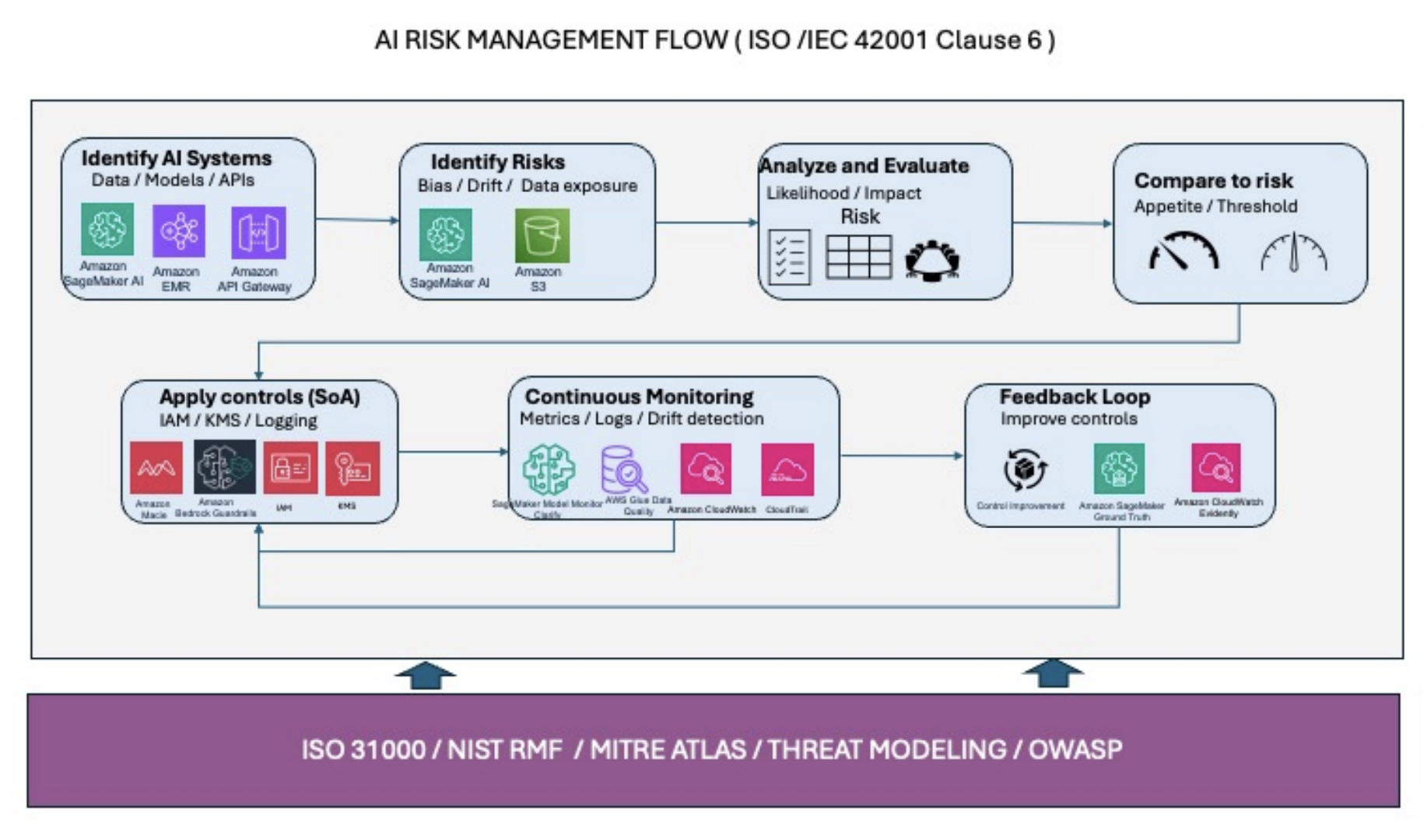
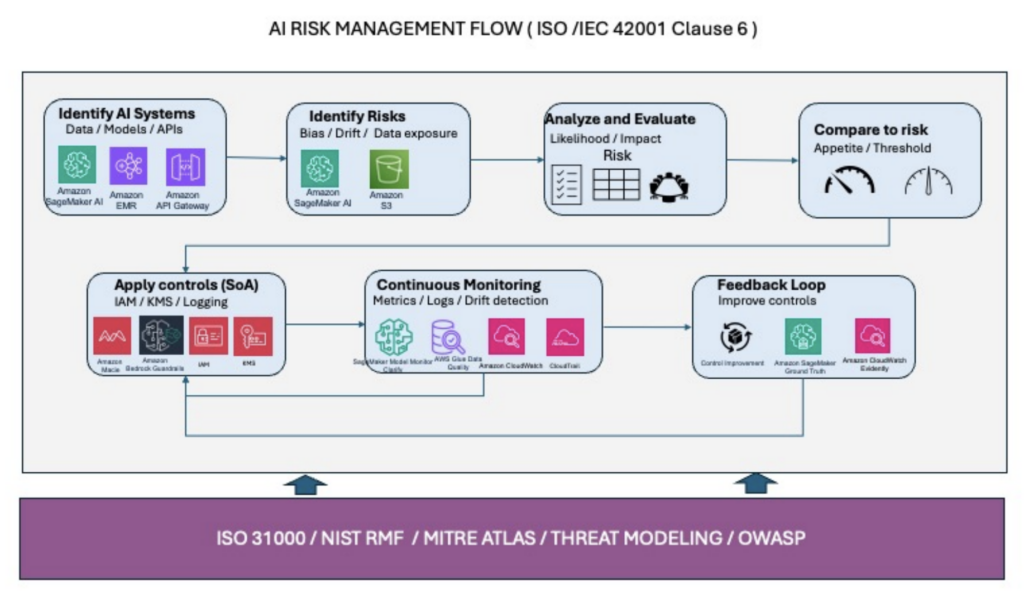
Figure 1 illustrates the AI risk management flow, star6ng with iden6fying AI systems and associated risks, analyzing and evalua6ng their impact, comparing against defined risk appe6te, and applying appropriate controls. The lifecycle is supported by ongoing monitoring and a feedback loop so that control effec6veness improves across AI environments. AWS services map to each stage: • SageMaker AI, Amazon EMR, and API Gateway for iden6fying AI systems • SageMaker AI and Amazon S3 for risk iden6fica6on • IAM, AWS KMS, Macie, and Amazon Bedrock Guardrails for applying controls • SageMaker AI Model Monitor, AWS Glue Data Quality, CloudWatch, and CloudTrail for ongoing monitoring • Amazon SageMaker Ground Truth for the feedback loop.

Artificial Intelligence (AI), Generative AI, and Agentic AI do not fit within historical IT in enterprise governance and compliance strategy. In present-day operational reality, there is an urgent need for governance frameworks that organizations can implement to address the risks posed by these technologies. To meet these challenges, AWS has released its AI compliance guide, “Implementing ISO/IEC 42001:2023 AI Management Systems (AIMS) on AWS” (PDF).

The May 2016 guide gives cloud teams a structured, practical resource for building an Artificial Intelligence Management System (AIMS) on AWS. This isn’t just a document for legal and compliance departments, but rather a hands-on reference that architects, security engineers, and AI developers can use to align their workloads with globally recognized standards. It specifically outlines what services to use and how to use them to meet compliance. As generative and agentic AI adoption accelerates, understanding this framework is now a core professional competency. For certification candidates and practitioners alike, this guide marks a meaningful milestone in AWS’s formalization of AI guidance in the cloud.

A Shared Responsibility

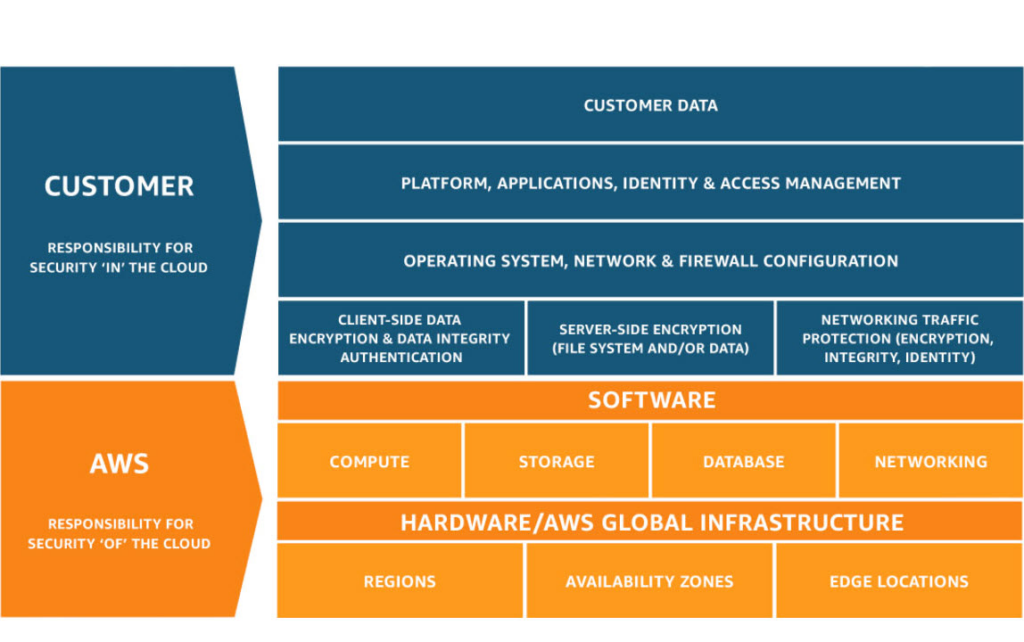
Remember that when running your AI workloads in the cloud, you adhere to the shared responsibility model. AWS states:

AI Security and AI Compliance are a shared responsibility between AWS and the customer. This shared model can help relieve the customer’s operational burden as AWS operates, manages and controls the components from the host operating system and virtualization layer down to the physical security of the facilities in which the service operates. The customer assumes responsibility and management of the guest operating system (including updates and security patches), other associated application software as well as the configuration of the AWS provided security group firewall. Customers should carefully consider the services they choose as their responsibilities vary depending on the services used, the integration of those services into their IT environment, and applicable laws and regulations. The nature of this shared responsibility also provides the flexibility and customer control that permits the deployment. As shown in the chart below, this differentiation of responsibility is commonly referred to as Security “of” the Cloud versus Security “in” the Cloud.

What Is ISO/IEC 42001:2023?

ISO/IEC 42001:2023 is the first international standard specifically designed for AI management systems, published by the International Organization for Standardization. It establishes requirements for organizations to responsibly develop, deploy, and manage AI. It covers everything from risk assessment and transparency to human oversight and continual improvement. Think of it as the AI equivalent of ISO 27001 for information security — a structured management system approach rather than a checklist. For organizations operating in regulated industries such as finance, healthcare, or government, aligning with this standard is rapidly becoming a contractual and regulatory expectation.

What the AWS AI Compliance Guide Actually Covers

The AWS ISO/IEC 42001:2023 guide provides service-level mappings showing how AWS tools and services support specific clauses in the standard. It covers areas including AI risk management, data governance, model transparency, security controls, and organizational accountability structures. Key AWS services referenced in this context include Amazon Bedrock, Amazon SageMaker, AWS CloudTrail, AWS Config, and AWS Security Hub, services that certification candidates will recognize from multiple exam domains. The guide also offers implementation guidance for teams to assess their current state and identify gaps before pursuing formal certification or audit readiness. For cloud professionals, this is the bridge between theoretical AI governance and tangible AWS architecture decisions.

Figure illustrates the AI risk management flow, star6ng with iden6fying AI systems and associated risks, 
analyzing and evalua6ng their impact, comparing against defined risk appe6te, and applying appropriate 
controls. The lifecycle is supported by ongoing monitoring and a feedback loop so that control 
effec6veness improves across AI environments. AWS services map to each stage: 
• SageMaker AI, Amazon EMR, and API Gateway for iden6fying AI systems
• SageMaker AI and Amazon S3 for risk iden6fica6on
• IAM, AWS KMS, Macie, and Amazon Bedrock Guardrails for applying controls
• SageMaker AI Model Monitor, AWS Glue Data Quality, CloudWatch, and CloudTrail for ongoing 
monitoring
• Amazon SageMaker Ground Truth for the feedback loop.

AWS Training and Certification Domains and Exams

🎓 This guide is relevant across several AWS certification tracks, and candidates should treat it as supplemental reading material:

The AWS Certified AI Practitioner exam covers responsible AI, governance, and the operational aspects of AI workloads. This guide maps almost perfectly to those objectives. The AWS Certified Security Specialty exam tests deep knowledge of compliance frameworks, audit readiness, and how AWS services support regulatory requirements, all of which appear in this guide. The AWS Certified Solutions Architect – Professional exam challenges candidates on governance at scale, multi-account compliance strategies, and the design of systems for risk. Even candidates pursuing the AWS Certified Machine Learning Engineer Associate will benefit from understanding how governance wraps around the ML lifecycle. Familiarity with standards like ISO/IEC 42001 increasingly differentiates senior-level candidates from those with only technical depth.

Building a Compliant Generative AI Platform

Picture a healthcare technology company that has just deployed a generative AI assistant using Amazon Bedrock to help clinical staff summarize patient records. The product is technically functional, but the CISO raises a red flag: “We have no documented AI risk management process, no model transparency controls, and nothing showing human oversight is built in.” Enter the ISO/IEC 42001:2023 on AWS guide. The Solutions Architect and Security Engineer use it to map their Bedrock implementation to standard clauses — enabling AWS CloudTrail for model invocation logging, using AWS Config rules to enforce guardrails, and documenting human review workflows as part of the AIMS. Within weeks, the team will have a defensible governance posture they can present to regulators, auditors, and executive leadership. This is exactly the kind of scenario that appears in professional-level exam case studies — and exactly the kind of work enterprises need practitioners who can execute.

Why Cloud Professionals Should Add AI Governance to Their Skill Set Now

The integration of AI into cloud architecture is no longer optional for most enterprises, and neither is the governance layer that surrounds it. Compliance frameworks like ISO/IEC 42001 are moving from “nice to have” to “required before deployment” in many organizations, particularly those operating across international jurisdictions. Cloud professionals who can speak the language of AI risk management and translate it into AWS service configurations will hold a significant advantage in job roles ranging from Solutions Architects to AI/ML Engineers to Cloud Security Consultants. AWS publishing this guide is a strong signal that AI governance knowledge will increasingly appear in updated exam blueprints and job descriptions. Now is the time to get ahead of that curve, not catch up to it.

Closing: Turn Compliance Knowledge Into Career Currency

Understanding frameworks like ISO/IEC 42001 and how AWS operationalizes them is exactly the kind of depth that separates good cloud and AI practitioners from exceptional ones. At Tech Reformers, we bring real-world context to the official AWS curriculum — helping you connect compliance concepts like these to hands-on labs, real architecture scenarios, and the exam domains that matter most. Whether you’re preparing for your next AWS certification or leveling up your enterprise cloud skills, we’re here to help you build knowledge that transfers directly to the job.

👉 Explore our upcoming training programs at https://techreformers.com — and follow us so you never miss an announcement that could impact your certification journey or your career.

HRB Report

The 4 Pillars Every Engineering Leader Needs


Your business runs on software. AI Development is the key to moving forward.

That’s why the pressure to ship faster without compromising quality, security, or compliance has never been higher. A Harvard Business Review Analytic Services white paper, sponsored by AWS, lays out exactly how high-performing engineering organizations are meeting that challenge.

The report calls out four interrelated pillars of modern software development. Get them right, and you innovate. Get them wrong, and you accumulate legacy debt that will slow you down for years.

Here’s the distilled version for engineering leaders — plus a path to upskill your team on AWS.

📄 Download the full HBR Analytic Services white paper (PDF) → Embracing Modern Software Development Practices in the AI Era


The Stakes Have Changed

Forrester analyst Diego Lo Giudice frames it bluntly: software is how your business expresses itself. Every process, policy, and service runs through it.

By 2028, Forrester expects software delivery to look radically different — teams building applications at speeds that seem impossible today. The organizations that get there will be the ones that redesign their entire pipeline, not just their code editor.

The four pillars that get you there:

  1. Speed and agility
  2. Visibility through testing and observability
  3. AI-powered development agents and automation
  4. Embedded security and governance

Let’s break them down.


Pillar 1: Speed and Agility

Traditional waterfall development is dead and has been since Agile and DevOps took over. Development leaders already know this, but the execution gap is real.

AT&T’s Brian Hinshaw shared a telling data point in the report. Before modernizing, his team shipped one or two apps a year. After embracing modern practices — microservices, low-code platforms, and DevOps — productivity exploded to 60 or 70 apps per quarter.

That’s not a typo. That’s a 100x throughput improvement.

How? A combination of:

  • Microservices architecture that decouples deployment from monoliths
  • Automated CI/CD pipelines for frequent, reliable releases
  • Agile methodology paired with DevOps tooling (Accenture’s Adam Burden notes you can’t really do one without the other)

According to the Continuous Delivery Foundation, 83% of developers are already involved in DevOps activities. If your team isn’t, you’re already way behind.


Pillar 2: Improved Visibility Through Observability

Monitoring is not observability. That distinction matters more every year.

Capital Group’s Shawn Landreth describes joining a company that operated on a “distress protocol” — fix it after customers complain. A decade ago, that might have worked when systems were monolithic and had three layers. Today’s microservices architectures make that approach dangerous.

His team rebuilt around observability: predictive analytics on historical data, AI-driven noise reduction, and cross-functional operational calls that pull desktop support, help desk, and engineering into the same conversation.

The result? They cut 13,000 daily alerts down to under 1,000. Still a lot — but now actionable.


Pillar 3: AI-Powered Agents Automation

This is the pillar that’s changing fastest. Coding agents are changing the landscape!

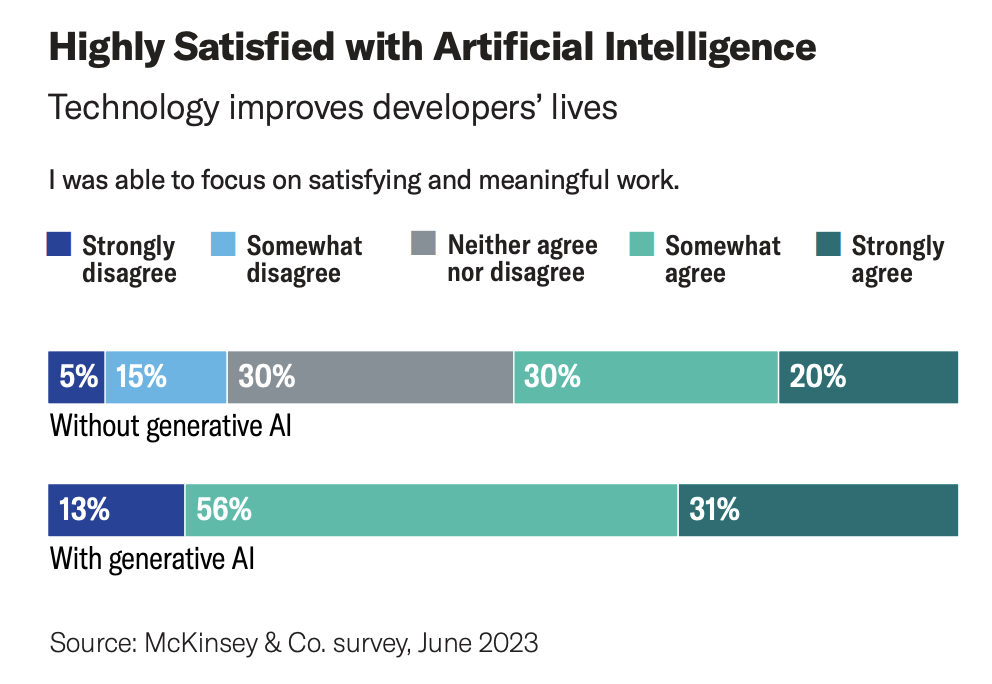
A McKinsey study found that 87% of developers using generative AI reported being able to focus on meaningful work — compared to just 50% of developers without it. That’s a massive quality-of-work gap, and it translates directly into retention and velocity.

Where is AI actually delivering? The HBR report highlights:

  • Code generation — natural language to working functions
  • Test case generation and defect prediction — Boston Consulting Group is embedding this into their QA process right now
  • Alert triage and root cause analysis — AI sitting in the middle of the observability stack
  • Predictive project analytics — forecasting delays before they happen
Kiro powers

💡 The key insight: AI isn’t replacing developers. It’s absorbing the tedious work so humans can do the creative work. As you know, this study needs to look again for 2026 as coding agents are taking over. Our new article on Kiro and Claude Code will dive deep into using these with AWS. Of course, there are others and more keep popping up.


Pillar 4: Embedded Security and Governance

Speed without guardrails is how you end up in a breach notification.

U.S. Steel’s Adam Airhart inherited a decade of legacy systems with an unclear risk profile. His fix wasn’t dramatic. He started with version control on an AI-powered platform, then added build-and-release pipelines, and then added approval gates at every critical transition.

Developers got instant feedback. Security became part of the flow instead of a gate at the end.

This is the DevSecOps model, and it’s non-negotiable for regulated industries. HealthTech and FinTech leaders especially feel this — compliance isn’t optional, and bolting it on after the fact costs 10x more than building it in.

Accenture’s Burden warns against both extremes: too strict, and you kill innovation, too loose, and you build future technical debt. The companies that win have strong central governance paired with architects who can translate policy into developer-friendly guardrails.


The Skills Gap Is the Real Bottleneck

Here’s the uncomfortable truth. The pillars are well understood. The tooling exists. AWS provides the services.

What’s missing at most organizations is a team trained to actually execute.

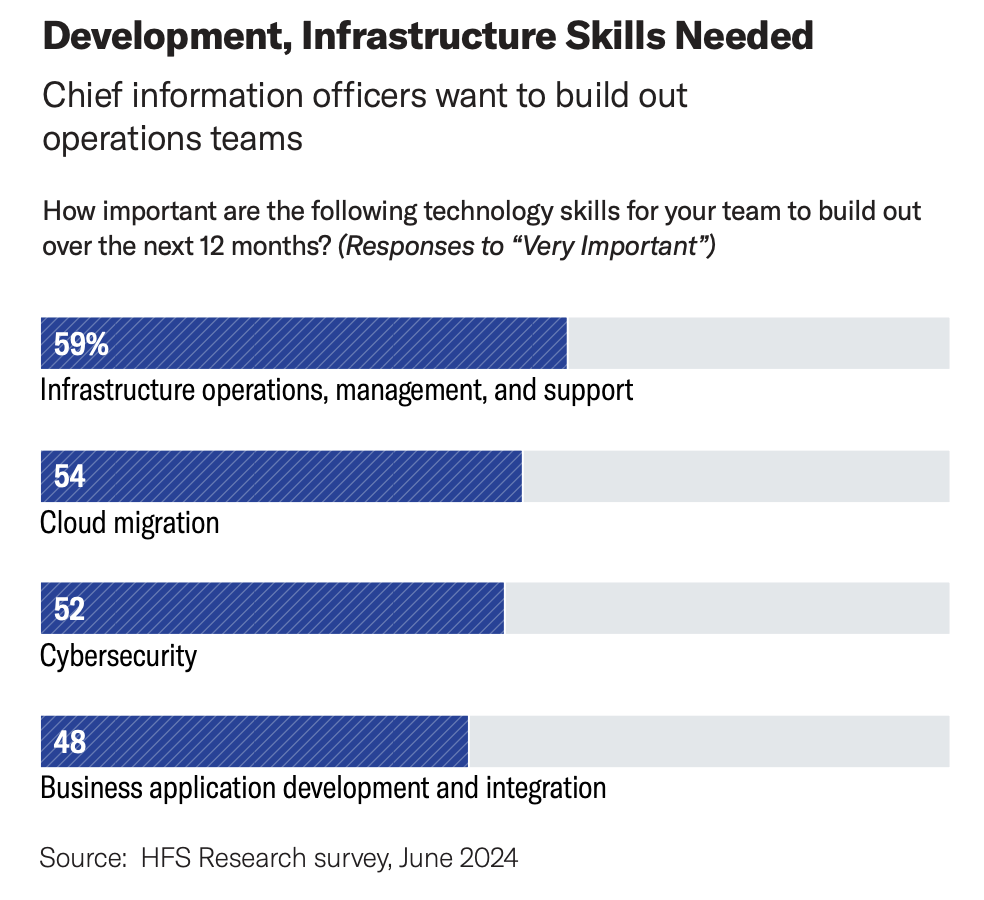
HFS Research found that 59% of CIOs rate infrastructure operations skills as “very important” to build out in the next 12 months. Cloud migration, cybersecurity, and business application development follow close behind.

If you’re an engineering leader, you have two options: wait for the market to solve your hiring problem, or upskill the team you have.


Two Training Paths to Get Your Team There

Tech Reformers is an AWS Authorized Training Provider and AWS AI Champion. We built our curriculum around the exact pillars HBR identifies.

Developing on AWS (3 days)

This is the foundational course for experienced developers moving workloads to AWS. Your team will build a full cloud application — IAM permissions, S3 and DynamoDB integration, Lambda functions, API Gateway, Cognito authentication, and X-Ray observability. DevOps practices are embedded throughout.

It directly addresses Pillars 1, 2, and 4. Microservices, serverless, observability, and security patterns are all hands-on.

Intermediate level. Next cohort starting soon.

Advanced Generative AI Development on AWS (2 weeks)

This is Pillar 3, operationalized. Your team will build production-ready generative AI solutions on AWS — foundation model selection, vector databases with Amazon Bedrock Knowledge Bases, prompt governance, agentic AI with AgentCore, AI safety guardrails, and cost optimization.

This is the course for teams that have moved past ChatGPT experiments and need to ship enterprise-grade AI with real governance.

Advanced level.


Change Is the Only Certainty

Lo Giudice closes the HBR report with a line that should be taped to every engineering leader’s monitor: “Agile transformation is a process that never ends.”

Three years ago, nobody predicted ChatGPT would redefine software development. Three years from now, something else will.

Your modern software practices need to be ready for anything — because change itself is the only constant.

Next steps:

  1. Download the full HBR white paper (PDF) — share it with your leadership team
  2. Register for Developing on AWS — get your engineers building modern cloud applications
  3. Register for Advanced Generative AI Development — move your AI work from prototype to production

Questions about which class fits your team? Email us at info@techreformers.com or call (206) 401-5530.

Civic AI Agent

Local governments sit on a mountain of public information including municipal codes, ordinances, permitting requirements, and service guides. Yet, hardly anyone can find information they want. Residents call city hall to ask questions that are already answered in a public document. Staff spend time answering the same questions over and over. The information exists; it just isn’t accessible.

Civic AI Agent is our answer. It’s a conversational assistant that lets residents ask questions and get accurate, cited answers drawn directly from official city documents with no hallucinations, no guessing, no dead-end search results.

We recently built a proof of concept for the City of Ruston. The architecture is designed to be replicated for any city, school district, county agency, or public organization.

Civic AI Agent at https://ruston-ai.techreformers.com/

What Is Civic AI Agent?

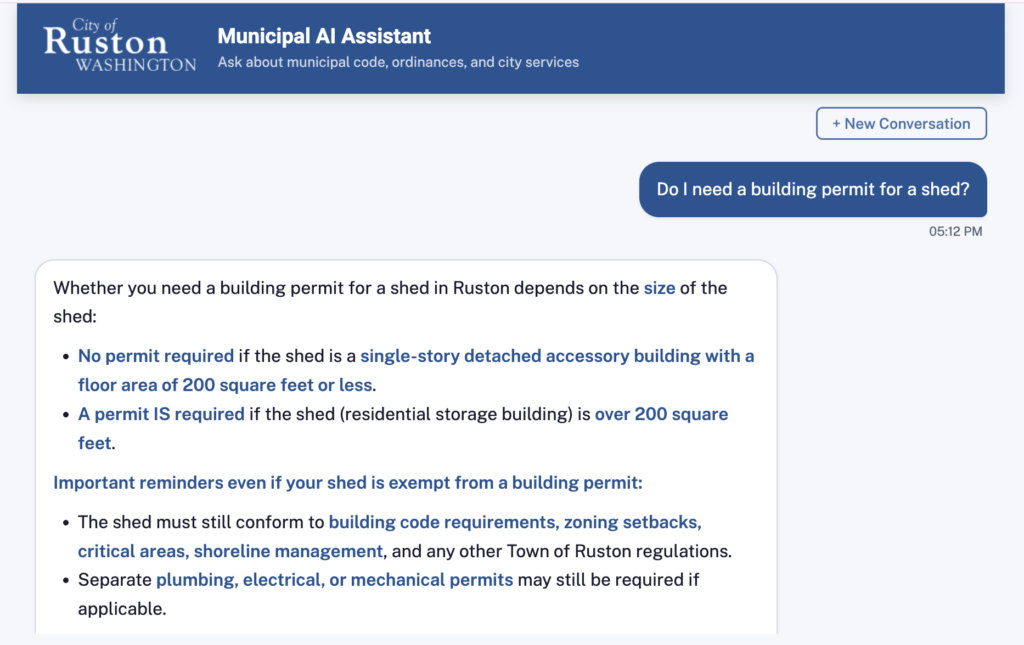
Civic AI Agent is a web-based chat interface built on AWS serverless architecture. Residents type a question like “What are the noise ordinance rules for construction?” or “How do I apply for a home occupation permit?” and receive a grounded answer with citations linking back to the exact section of the municipal code or ordinance that supports it.

The system is not a general-purpose chatbot. It only answers from documents you have explicitly indexed. That means every answer is traceable, auditable, and grounded in official city content.

Who Is It For?

  • Cities and municipalities with municipal code, ordinances, city services, permitting
  • School districts with policies, handbooks, enrollment requirements, board decisions
  • County agencies with zoning regulations, health codes, public records
  • Any organization with a large body of public-facing documents that residents or stakeholders need to navigate

Why an Agent? Not Just a Chatbot?

This is the most important architectural decision we made, and it shapes everything about where the product can go.

A chatbot answers questions. If you ask “How do I get a pet license?” it tells you the steps. That’s useful, but it’s still just a search engine with intelligent phrasing.

An AI agent can act. It has access to tools like APIs, forms, databases, external systems. Agents can execute multi-step workflows on your behalf. The difference looks like this:

ChatbotAgent
“Here are the steps to apply for a pet license.”“I’ve started your pet license application. Here’s what I need from you to complete it.”
“Your utility bill is due on the 15th.” “I’ve scheduled your utility payment for the 14th. Here’s your confirmation.”
“The park permit form is at this link.”“I’ve submitted your park reservation request for Saturday. You’ll receive a confirmation by email.”

Civic AI Agent is built on Amazon Bedrock Agents, which provides the orchestration layer that makes this possible. In its current form, the agent answers questions grounded in city documents. But because it is a true agent, not a chatbot, it can be extended with action groups that connect to permitting systems, payment processors, scheduling platforms, or any REST API the city exposes.

The foundation is already in place. Adding new capabilities is a matter of connecting new tools, not rebuilding the system.

In Practice: The City of Ruston

The City of Ruston proof of concept indexes the full municipal code and key pages from the city website. Residents ask questions and receive cited answers linked back to the source document. The City Clerk’s office manages the knowledge base, monitors resident interactions, and identifies documentation gaps through the admin portal — no engineering involvement required for day-to-day operations.

The proof of concept is the first deployment of the architecture. As it matures, we will share what we learn about resident usage patterns, the kinds of questions that surface documentation gaps, and how agent-based civic tools perform in a real municipal context.

Key Capabilities

Natural Language Q&A with Source Citations

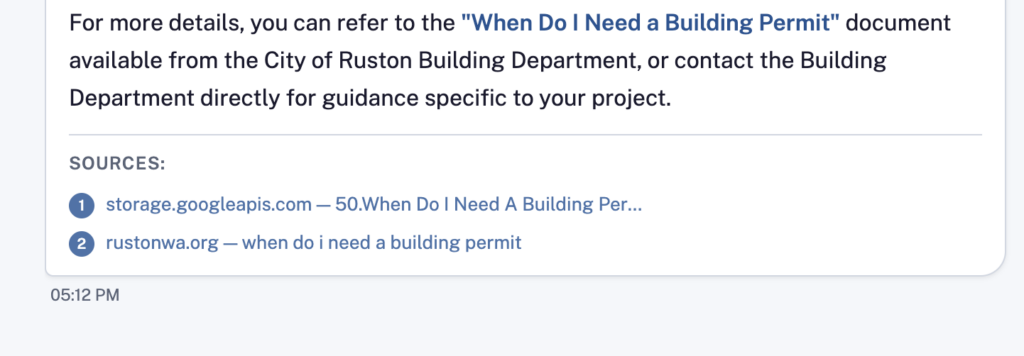
Residents ask questions the way they would ask a person. The agent retrieves the most relevant document chunks, synthesizes an answer, and cites the source including a direct link to the original document.

Sources cited

Retrieval-Augmented Generation (RAG)

Civic AI Agent uses the RAG pattern, the industry standard for grounded AI responses for internal resources. Rather than relying on a language model’s training data, every answer is assembled from documents you control. The model cannot fabricate information that isn’t in your knowledge base. We use Bedrock Knowledge Bases, which can crawl websites or point to specific knowledge stores.

Admin Portal with Knowledge Base Management

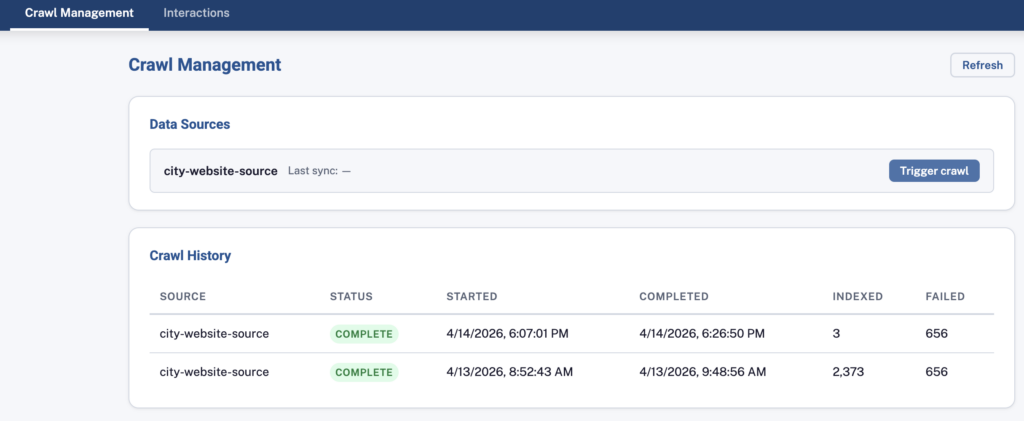
City Clerk’s staff manage the system through a secure admin portal. They can trigger crawls of city websites, monitor indexing jobs, and review every interaction residents have had with the assistant. No engineering involvement is required for day-to-day operations. They never need to use the AWS console to manage their data.

Manage Content

Interaction Analytics

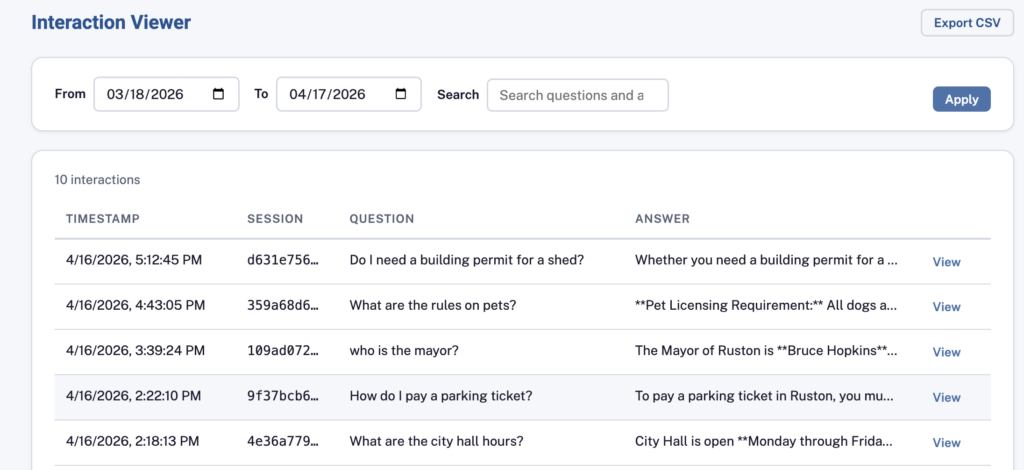
Every question and answer is stored in a structured database. Administrators can browse and search all interactions to identify common resident questions, discover gaps in documentation, and improve city services.

Review all interactions online.

All interactions pass through Amazon Bedrock Guardrails, which filter harmful content, block prompt injection, and keep responses within the scope you’ve defined, a non-negotiable for a public-facing agent representing the city.

AWS Serverless Architecture

Civic AI Agent is built entirely on AWS managed services. There are no servers to patch, no infrastructure to capacity-plan, and no operational overhead beyond the application itself. It scales automatically from zero to thousands of concurrent users.

DIAGRAM: Architecture overview — Amplify → API Gateway → Lambda → Bedrock Agent → Knowledge Base → DynamoDB]

Infrastructure as Code with AWS CDK

Every resource in the system, Lambda functions, API Gateway stages, DynamoDB tables, Cognito user pools, CloudWatch alarms, is defined in code using AWS Cloud Development Kit (CDK). There is no manual console configuration. The entire infrastructure can be deployed from scratch with a single command.

CDK lets us write infrastructure in TypeScript, the same language the team already knows. Constructs are composable, type-safe, and version-controlled alongside the application code. When a new customer needs a deployment, the template is forked, a configuration file is updated, and `cdk deploy` stands up a complete, production-ready environment.

This approach means:

  • Repeatability – every deployment is identical; no manual steps that can be forgotten or misconfigured
  • Auditability – infrastructure changes go through code review, just like application code
  • Teachability – new engineers can read the CDK stacks and understand exactly what is deployed and why

One Resource Per Layer — Environment Isolation Without Duplication

Rather than deploying entirely separate infrastructure stacks for dev and prod, each AWS service provides its own isolation mechanism:

  • Bedrock Agents: One agent with two aliases — a draft alias routes to the in-development version (dev), a pinned alias routes to the stable promoted version (prod)
  • Lambda: One function per handler with `dev` and `prod` aliases — the dev alias always tracks the latest version; the prod alias is explicitly promoted after testing
  • API Gateway: One REST API with `dev` and `prod` stages — stage variables route each request to the matching Lambda alias at runtime, with no code duplication
  • Amplify: One app with `dev` and `prod` branches — the branch determines the environment automatically
  • DynamoDB / Cognito: Separate tables and user pools per environment — data and authentication isolation is required at these layers

One codebase. Two environments. No duplicated infrastructure stacks.

This pattern eliminates configuration drift between environments, reduces infrastructure cost, and mirrors exactly how AWS intends these services to be used.

Infrastructure changes (CDK stacks) follow the same review-and-promote pattern through AWS CodePipeline with an audit trail, approval gates, and a fully automated path from development code commit to production.

Observability Built In

Every deployment includes CloudWatch dashboards and alarms out of the box:

  • API Gateway request volume, error rates, and p99 latency
  • Lambda duration, error counts, and throttles
  • DynamoDB system health
  • AWS X-Ray distributed tracing for end-to-end request visibility

Why These Choices Matter

Every architectural decision in Civic AI Agent is defensible and teachable. We chose Amazon Bedrock Agents over building our own orchestration layer because the agent primitive is where AWS is investing. Guardrails, and knowledge base integration are first-class features, not glue code we have to maintain. We chose CDK over console configuration because infrastructure that only exists as clicks in a console can’t be code-reviewed, can’t be diffed, and can’t be reproduced from scratch — and that means your team doesn’t really own it. We chose aliases and stages over duplicated stacks because that is how AWS designed these services to support multiple environments.

For a technical buyer, this matters in two ways. First, nothing here is exotic. Any engineer fluent in AWS serverless patterns can read the CDK, understand the Bedrock Agents configuration, and extend the system. Second, every pattern in this build is one we teach in our instructor-led classes. When we hand this system to your team, they are not inheriting a black box. They are inheriting a reference implementation of the same patterns they will see in training.

AWS Well-Architected Framework Alignment

Civic AI Agent is built to the AWS Well-Architected Framework across all six pillars:

AWS Well-Architected PillarHow We Address It
Operational ExcellenceAWS CDK infrastructure as code, CI/CD via Amplify and CodePipeline, CloudWatch dashboards and alarms
SecurityIAM least-privilege roles, Cognito MFA, Bedrock Guardrails, no hardcoded credentials
ReliabilityServerless and multi-AZ managed services
Performance EfficiencyServerless auto-scaling and graceful error handling
Cost OptimizationPay-per-request on Lambda, DynamoDB, and AI model invocation, no idle compute, shared resources across environments
SustainabilityServerless eliminates over-provisioned capacity; shared Bedrock Agents reduces resource duplication

Deploying for a New City

The architecture is designed to be replicated. Each new customer gets their own AWS account with a full, independent deployment, not a shared multi-tenant system. That means complete data isolation, independent scaling, and no blast radius between customers. Because the entire stack is defined in CDK, standing up a new city is a matter of forking the template, updating a configuration file, and running cdk deploy. A new base environment is live in under an hour. The real work is defining your data sources and how you want your agents to work.

About Tech Reformers

Tech Reformers is an AWS Advanced Services Partner and AWS Authorized Training Partner (ATP). We design and build cloud-native solutions on AWS, and we train the developers who build and the DevOps engineers who maintain them.

Tech Reformers logo

Civic AI Agent is both a production product and a reference implementation, every architectural decision demonstrates the AWS patterns our instructors teach in the classroom. When we hand a project to a client’s engineering team, they receive working code and the training to own it.

If you’re a city, school district, or public agency interested in deploying Civic AI Agent, contact us. If you’re an engineering organization looking to upskill your team on AWS serverless and generative AI patterns, see our upcoming instructor-led training.

financial worker calculating profit using notebook and calculator

Amazon Bedrock Now Ties AI Cost to IAM Users and Roles

Generative AI workloads are exciting — until the AWS bill arrives and no one knows who spent what. Amazon Bedrock’s new support for IAM principal-based cost allocation solves one of the most practical pain points in enterprise AI adoption: cost visibility and attribution. With this update, organizations can connect Bedrock model inference spending directly to the IAM users and roles making those calls. It’s a quiet but powerful addition that sits at the intersection of FinOps, identity management, and generative AI governance. For certification candidates and working cloud professionals alike, this is the kind of feature that shows up in exam scenarios and architecture reviews.

What Changed and How It Works

Previously, understanding which teams or applications were driving Amazon Bedrock inference costs required custom logging workarounds or third-party tooling. Now, AWS has built this capability natively into AWS Cost and Usage Report 2.0 (CUR 2.0) and Cost Explorer. The mechanism is straightforward: tag your IAM users and roles with meaningful attributes — such as team, project, or cost center — then activate those as cost allocation tags in the Billing and Cost Management console. From there, you either enable “Include caller identity (IAM principal) allocation data” when setting up a CUR 2.0 data export, or filter directly by those tags inside Cost Explorer. The result is granular, auditable cost attribution for every Bedrock inference call made under those principals.

Why This Matters for AI Cost Management

Well-Architected icon

Cost optimization is not a nice-to-have in enterprise cloud design — it is a core pillar of the AWS Well-Architected Framework, and Solutions Architects are expected to design for it from day one. This feature gives architects a native mechanism to enforce cost accountability without building custom pipelines. For CloudOps engineers managing shared environments, this means the end of reactive cost conversations in which no one can identify the source of a spike. Tagging IAM roles by application or team is already standard practice in resource management, and this update extends that discipline to AI inference workloads. Operationally, it also creates a clean paper trail for chargebacks, budget approvals, and financial reporting across business units.

A Real-World Scenario Worth Walking Through

save dollars

Imagine a financial services company running three internal Bedrock-powered tools: a document summarizer for the legal team, a customer email assistant for support, and a risk analysis copilot for the trading desk. Each application uses a separate IAM role. Before this update, Bedrock costs appeared as a single undifferentiated line item — frustrating for both engineering and finance. With IAM principal cost allocation enabled, the CloudOps team tags each role with the appropriate cost center and activates those tags in billing. Now the monthly CUR 2.0 report shows exactly how much each application consumed, down to the model and the time period. Finance can allocate costs accurately, leadership can make informed build-versus-buy decisions, and engineers can optimize the highest-cost workloads first.

The Certification Angle You Should Not Ignore

This feature is directly relevant to several AWS certification exams, and candidates should treat it as a test-worthy concept. The Solutions Architect Associate and Professional exams both emphasize cost optimization, tagging strategies, and the use of Cost Explorer and CUR for attribution — all of which appear here. For anyone studying these certifications, the ability to explain why IAM tagging supports financial governance in a multi-team AI environment is exactly the kind of scenario-based reasoning those exams reward.

hand-holding-dollar-icon

At TechReformers, we bring announcements like this to life with real-world labs, demos, and scenario walkthroughs that go well beyond the slide deck. Whether you are preparing for a certification or building enterprise AI infrastructure, we help you connect the dots between AWS features and actual business outcomes. Visit us at 🔗 https://techreformers.com to explore our training programs and stay ahead of what AWS is shipping.

Tech Reformers Chat
Open Tech Reformers Chat