

If you run more than one VPC, or you’re about to set up your first Site-to-Site VPN back to an office or data center, there’s a decent chance AWS Transit Gateway belongs in your architecture sooner than you think. It’s usually framed as a large-enterprise tool, but the way it’s priced and provisioned makes it just as useful for a five-VPC startup as it is for a Fortune 500 network team. And this week, it got a lot more capable: AWS just announced the general availability of Policy-Based Routing (PBR) on Transit Gateway, giving network architects a level of traffic control that previously required expensive workarounds.
This post covers both halves of that story: what Transit Gateway is and why it’s worth considering even for a small AWS footprint, and what this new Policy-Based Routing capability actually changes for security, hybrid connectivity, and certification prep.
Key takeaways
- AWS Transit Gateway is a managed, pay-as-you-go network hub — you can start with a single VPN attachment and scale up without re-architecting.
- Policy-Based Routing (PBR), GA as of July 2026, lets Transit Gateway route traffic based on source/destination IP, port, and protocol — not just destination IP.
- PBR simplifies traffic inspection, hybrid path selection (VPN vs. Direct Connect), and environment isolation without extra VPCs or attachments.
- It’s already exam-relevant for the AWS Certified Advanced Networking – Specialty and AWS Certified Solutions Architect – Professional certifications.
What Is AWS Transit Gateway, and Why Should Smaller AWS Customers Care?
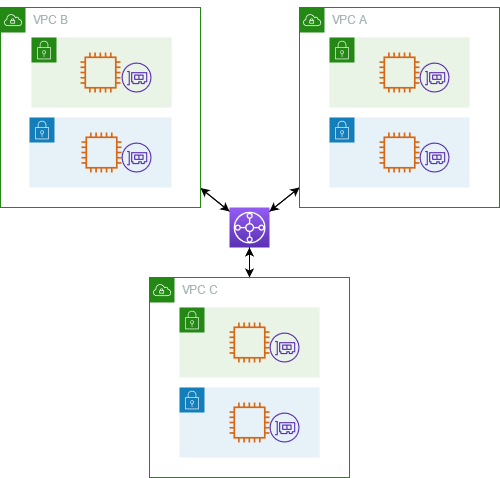
AWS Transit Gateway is a managed network transit hub that connects VPCs, VPNs, and AWS Direct Connect links through a single, central gateway, rather than a tangle of point-to-point connections. AWS describes it as giving you “better visibility and control” as your network grows — and that growth is really the point.
Most write-ups about Transit Gateway assume you already have dozens of VPCs and a full-time network team. In practice, it earns its keep much earlier than that. Here’s the pattern we see most often with smaller AWS environments:
- You need a Site-to-Site VPN back to an office or existing data center. Instead of attaching that VPN directly to a single VPC, you attach it to a Transit Gateway. The VPN attachment itself works almost identically either way — see AWS’s own Site-to-Site VPN setup guide — but routing through a Transit Gateway means that connection isn’t locked to one VPC forever.
- You add a second VPC (a new environment, a new team, an acquisition, a new region). Instead of standing up a new VPN or a peering connection, you attach the new VPC to the Transit Gateway you already have, and it inherits the existing hybrid connectivity automatically.
- You eventually add Direct Connect for more predictable latency or bandwidth. It attaches to the same gateway, alongside your VPN, without touching your VPC route tables.
The pricing model supports this incrementally: Transit Gateway bills by the hour per attachment plus data processed (see the official pricing page), so a single VPC and a single VPN attachment cost very little to run. You’re not paying an “enterprise tax” to keep the door open for growth. You’re just paying for what you use, with the option to expand later without a redesign. AWS’s own walkthrough on scaling VPN throughput using Transit Gateway is a good example of exactly this kind of incremental growth in action.
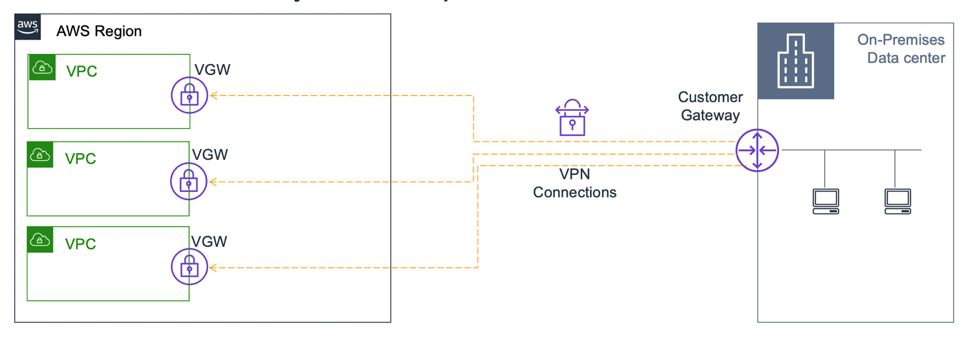
In other words: if you’re setting up your first VPN connection to AWS right now, it’s worth attaching it to a Transit Gateway from day one, even if you only have one VPC. It costs just a bit extra today and saves you a lot on a migration later. For the full mechanics of how traffic actually moves through the gateway, AWS’s “How Transit Gateway works” doc is the best primary source.
Transit Gateway Grows Up: Policy-Based Routing Brings Enterprise-Grade Traffic Control
That’s the foundation. Now here’s what changed this week for everyone already running Transit Gateway at scale.
Transit Gateway has long been the backbone of large-scale AWS network architectures, connecting VPCs, on-premises environments, and hybrid workloads at scale. But its routing model had a well-known limitation: forwarding decisions were based solely on destination IP address, which meant complex traffic-steering scenarios required creative and often costly workarounds. That changes with the general availability of Policy-Based Routing (PBR) on AWS Transit Gateway. This single capability addition has meaningful implications for how enterprise networks are designed, how security is enforced, and how certification candidates need to think about AWS routing architecture.
What Policy-Based Routing on Transit Gateway Actually Does
Traditional routing on Transit Gateway uses route tables that match on destination IP prefix — straightforward, but limited when you need to treat traffic differently based on where it came from, what port it uses, or what protocol it carries. Policy-Based Routing changes the decision model. With PBR, you create a policy table and associate it with a Transit Gateway attachment. Inside that table, you define an ordered list of rules, each evaluating packet attributes — source IP, destination IP, port, and protocol — rather than destination IP address alone. When a packet matches a rule, it’s forwarded to a designated route table, using first-match-wins logic for deterministic, predictable traffic classification.
Why This Matters for Security and Compliance Architectures
One of the most immediate use cases is inline traffic inspection. Before PBR, steering specific workloads through AWS Network Firewall or a third-party inspection appliance often required dedicated VPCs, extra routing hops, and additional Transit Gateway attachments just to create the path separation needed — a pattern AWS documents in its own guidance on connecting Transit Gateway directly to Network Firewall. Now, a security architect can write a policy rule that says: any traffic originating from the production application subnet, using HTTPS on port 443, goes to the inspection route table — and everything else takes a standard path. This shrinks the blast radius of a redesign, reduces the number of VPCs required for workload isolation, and cuts the operational overhead of maintaining parallel routing topologies. For organizations operating under PCI-DSS, HIPAA, or FedRAMP requirements, this kind of deterministic traffic steering is not a nice-to-have — it’s a compliance requirement.
Hybrid Connectivity Gets More Flexible Too
PBR also unlocks smarter use of hybrid connectivity paths. Enterprises running both AWS Direct Connect and AWS Site-to-Site VPN often want to route certain traffic types — say, database replication or backup jobs — over the lower-cost VPN path, while sending latency-sensitive application traffic exclusively over Direct Connect. Previously, achieving this required separate attachment architectures or complex BGP manipulation. With PBR, you write rules that classify traffic by source subnet and protocol, directing each class to the route table associated with the correct hybrid path. Network engineers get the traffic-engineering control they’re used to from on-premises MPLS environments, expressed natively in the AWS console, CLI, or SDK — with no additional charge beyond standard Transit Gateway fees.
A Real-World Scenario: Isolating Environments Without Doubling Your Infrastructure
Imagine a mid-sized enterprise running production, staging, and development environments across multiple VPCs, all connected through a single Transit Gateway. The security team wants to ensure development traffic can’t reach production subnets — lateral movement is a real concern — but doesn’t want to stand up a separate Transit Gateway and replicate the entire connectivity model. With PBR, the network team creates a policy table that matches on source IP ranges belonging to the development VPC and directs that traffic to a restricted route table with no routes to production CIDRs. Production traffic follows a separate policy rule to a route table with full connectivity plus a mandatory pass-through the Network Firewall attachment. Two environments, one Transit Gateway, one policy table, clean separation — and the whole thing is auditable through AWS CloudTrail.
Certification and Career Implications
This announcement sits squarely within the scope of the AWS Certified Advanced Networking – Specialty exam, particularly the domains of network architecture design, traffic management, and hybrid connectivity. It also surfaces in the AWS Certified Solutions Architect – Professional exam in scenarios requiring workload isolation, cost-optimized routing, and security-integrated architectures. For CloudOps engineers, PBR introduces a new operational artifact — the policy table — that needs to be understood, monitored, and maintained as part of the Transit Gateway lifecycle. Expect scenario-based exam questions asking you to select the most operationally efficient way to achieve traffic inspection or environment isolation, where PBR is the correct answer over legacy multi-VPC workarounds. If you’re studying for either exam right now, add Transit Gateway Policy-Based Routing to your active review list immediately.
Frequently Asked Questions
Is AWS Transit Gateway worth it for a small AWS account?
Often, yes — especially if you’re setting up your first Site-to-Site VPN. Attaching that VPN to a Transit Gateway instead of directly to a VPC costs little extra and lets you add VPCs, sites, or Direct Connect later without re-architecting your network.
What is Policy-Based Routing (PBR) on AWS Transit Gateway?
PBR is a routing capability, generally available as of July 2026, that lets Transit Gateway forward traffic based on source IP, destination IP, port, and protocol, instead of destination IP address alone.
Does Policy-Based Routing cost extra?
No. According to AWS, PBR is included at no additional charge beyond standard Transit Gateway fees.
Which AWS certifications cover Transit Gateway PBR?
It’s directly relevant to the AWS Certified Advanced Networking – Specialty exam and shows up in scenario questions on the AWS Certified Solutions Architect – Professional exam.
Start Applying This, Not Just Knowing It
Reading about PBR is a start, but the real learning happens when you build a policy table, write a few rules, and watch traffic take different paths based on protocol and source. At TechReformers, we layer real-world scenarios and hands-on labs on top of the official AWS curriculum so what you learn sticks — and transfers directly to both the exam room and the architecture whiteboard. Whether you’re preparing for a certification, upskilling your enterprise network team, or setting up your very first VPN into AWS, this is a capability worth understanding early. Visit us at techreformers.com to explore our upcoming networking courses and labs, and follow TechReformers so you never miss a capability change that matters to your career.